
Contents
- What Is EAL?
- EAL Study Design + What You Need To Do
- SAC and Exam Conditions
- Understanding What the Prompt Is Asking
- English Fluency and Proficiency
- Resources
1. What Is EAL?
Given the richness in cultural backgrounds of the VCE student cohort, English as an Additional Language (EAL) is designed to bridge the linguistic gaps between local students (who will typically do mainstream English) and those from non-English speaking backgrounds (who will typically do EAL).
If you want to complete the VCE, it’s compulsory that you complete at least three units of an English subject (including Units 3 and 4), and if you’re eligible for EAL, it counts as your English subject.
To be eligible for EAL, you must meet both of the following criteria:
- You have not resided in Australia (or another English-speaking country) for more than 7 years in total.
- You have not been enrolled in schools where English has been the primary language of instruction for more than 7 years.
NOTE: EAL is also offered to students who are deaf or hard of hearing, even if the above criteria do not apply.
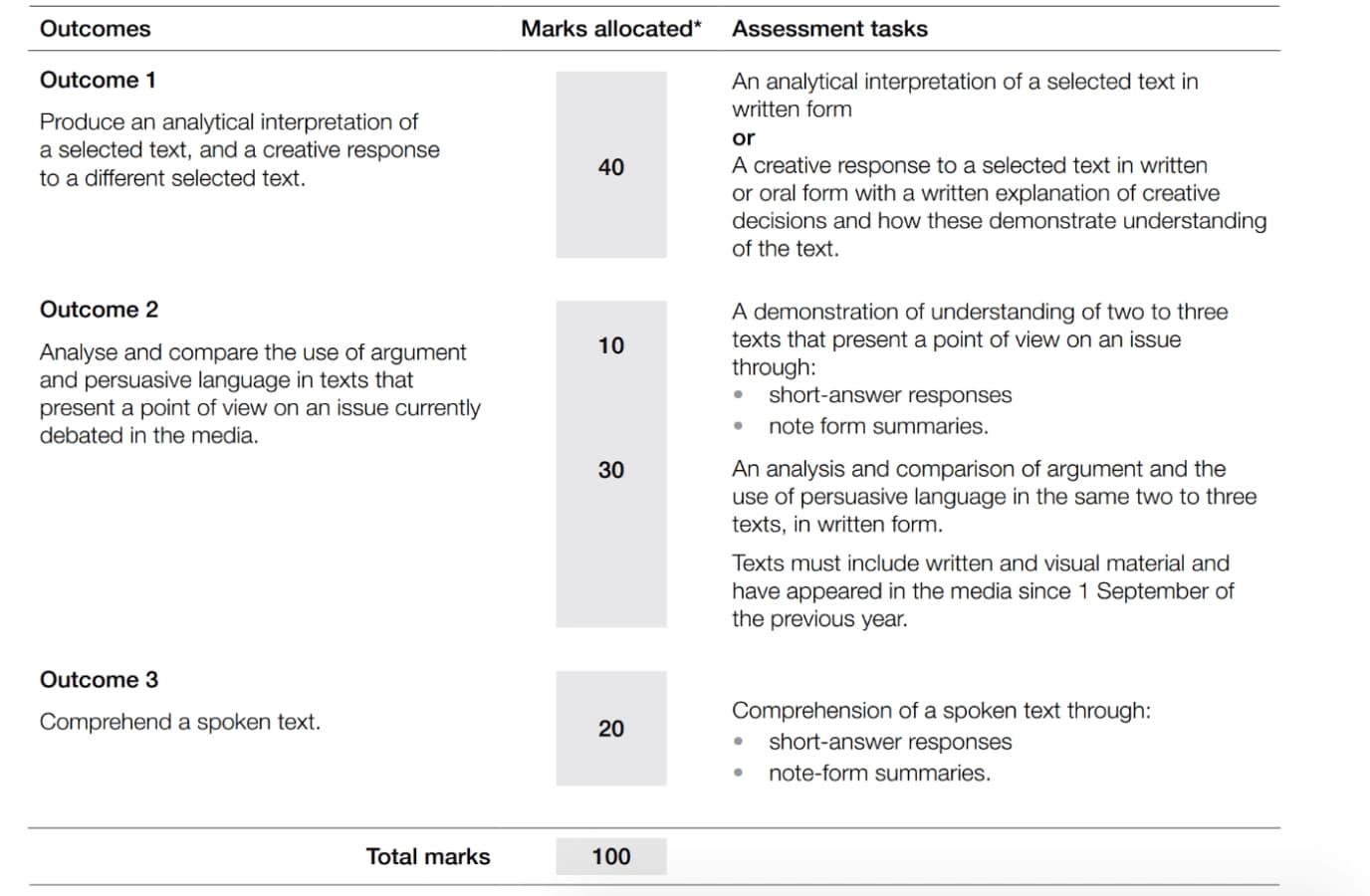
Since mainstream English and EAL are part of the same study design, there’s a LOT of overlap in the content, knowledge and skills students cover - you’ll all do Text Response, Language Analysis, Creative Writing and an Oral Presentation (the core Areas of Study or AoS), so many of your assessments will look quite similar.
There will be some differences though, which we'll expand on below.
As a starting point, we highly recommend you read through the four blogs we just linked so you can wrap your head around the core Areas of Study you’ll be studying - they give you a comprehensive overview.
2. EAL Study Design + What You Need To Do
In Year 11, your school will determine the assessment tasks you complete. Your Year 11 marks won’t actually contribute to your final Study Score.
Your Year 12 coursework will be split into Units 3 & 4. Let’s take a closer look at what’s involved here, as these marks do contribute to your final Study Score.
NOTE: As far as students are concerned, ‘Outcome’ just means ‘Area of Study’.
Starting with Unit 3:
 Outcome 1 refers to your Text Response, and Outcome 2 refers to your Creative.
Unit 3, Outcome 1: Text Response (worth 50% of your grade for Unit 3)
In your first AoS, you’ll complete:
- A Text Response essay, worth 30% of your grade for Unit 3
- Short-answer responses or note form summaries, worth 20% of your grade for Unit 3.
Your school will decide whether these two tasks are completed during the same SAC or in separate SACs.
Text Response: What You Need To Know
Key wording used by VCAA is that EAL students are expected to ‘discuss’ the ideas in their set text (whereas mainstream VCE English students have more pressure on them to ‘analyse’ their text). Let’s give you an example from Sunset Boulevard.
Discuss: The film presents Norma Desmond as a character who is unable to accept that her fame has faded, revealing the destructive effects of Hollywood's obsession with youth and success.
Analyse: Through the highly contrasted lighting and close-up shots of Norma's exaggerated facial expressions, Wilder presents her delusion as a product of Hollywood's relentless pursuit of youth, encouraging audiences to critique the industry's treatment of aging stars.
While we'd always encourage you to push yourself and analyse your text as deeply as possible - the key distinction here is that a 'discussion' of your text explains what the text shows and what it means, while an 'analysis' goes further, examining how the author or filmmaker constructs that meaning through specific textual choices.
Check out our Ultimate Guide to VCE Text Response for help with this essay.
Short-Answer Responses or Note Form Summaries: What You Need To Know
For this task, you’ll be shown an audio or audio-visual text that focuses on the historical, cultural and/or social context of the same text you’re writing your essay on. For example, you might watch an interview with the author where they discuss their inspiration for their text. This task is unique to EAL students.
Our blog on taking speedy notes during listening components is based around assessments from the previous EAL study design (so is slightly outdated), but it still has lots of useful tips you can use for this assessment. We’ve also linked a few other blogs to help you with listening tasks, down in Section 6: Resources under the Blogs heading.
Unit 3, Outcome 2: Creative (worth 50% of your grade for Unit 3)
In your second AoS:
- You’ll write a Creative piece inspired by your Framework of Ideas, worth 40% of your grade for Unit 3. Check out our Ultimate Guide to VCE Creative Writing for guidance on this.
- Then, you’ll produce a set of annotations that reflect on your writing process, worth 10% of your grade for Unit 3.
Set of Annotations: What You Need To Know
The style and weighting of these assessments are slightly different to mainstream English, but all of the core knowledge and skills they’re assessing you on are the same. Our blog on Written Explanations outlines the key elements you need to analyse in your annotations: Form, Language, Audience, Purpose and Context. Although the blog shows examples of the kinds of Written Explanations that mainstream English students are expected to write (full paragraphs, rather than annotations), it still gives you a clear picture of what you need to unpack in your set of annotations.
Now, moving onto Unit 4:
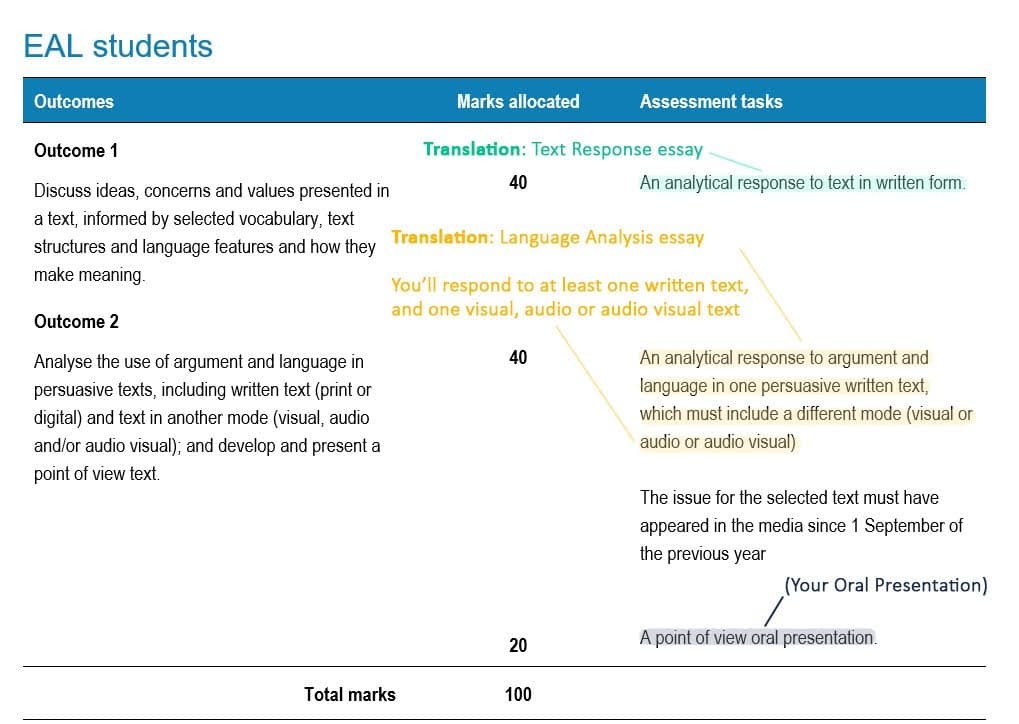
Outcome 1 refers to your Text Response, and Outcome 2 refers to your Language Analysis AoS, which includes your Oral Presentation.
Unit 4, Outcome 1: Text Response (worth 40% of your grade for Unit 4)
- You’ll complete another Text Response essay, worth 40% of your grade for Unit 4.
Same as Unit 3, key wording used by VCAA is that EAL students are expected to ‘discuss’ the ideas in their set text (whereas mainstream VCE English students have more pressure on them to ‘analyse’ their text). Head to our Ultimate Guide to VCE Text Response for more guidance. We touched on the difference between discussing and analysing above (for Unit 3) so refer back to that.
Unit 4, Outcome 2: Language Analysis/Oral Presentation (worth 60% of your grade for Unit 4)
- You’ll complete a Language Analysis essay, also worth 40% of your grade for Unit 4. See our Ultimate Guide to VCE Language Analysis for help with this. If you’re analysing an audio or audio-visual text for your Language Analysis, be sure to check out the blogs we’ve linked down in Section 6: Resources, under the Blogs heading.
- You’ll do an Oral Presentation, worth 20% of your grade for Unit 4. Our Ultimate Guide to VCE Oral Presentations will help you with this.
What Else You Need To Know
VCAA suggests writing 700 to 900 words for your Text Response, Language Analysis and Creative piece. They suggest that your set of annotations reflecting on your Creative should be around 250 words, but they haven’t specified how long your short-answer response or note form summary (for Unit 3) should be. Keep in mind that it’s about quality, not quantity, and for anything internally marked, it’s important to keep your teacher’s preferences in mind!
4. SAC and Exam Conditions
Your EAL exam will be almost identical to the mainstream English exam. There are some key differences though.
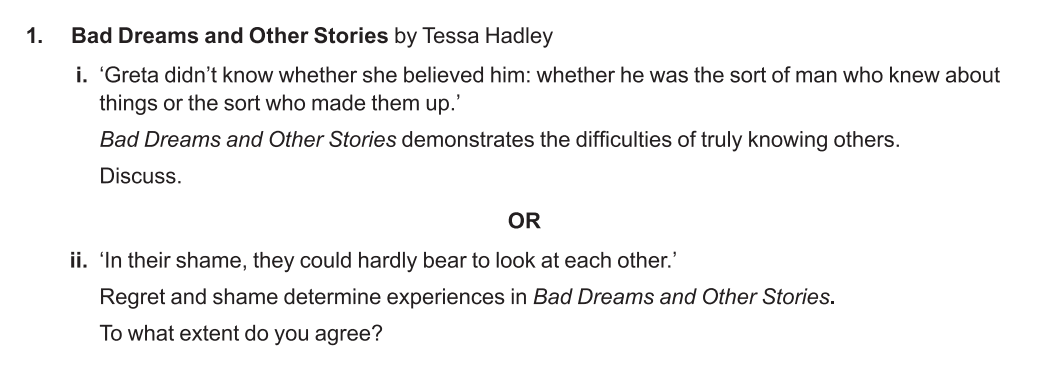
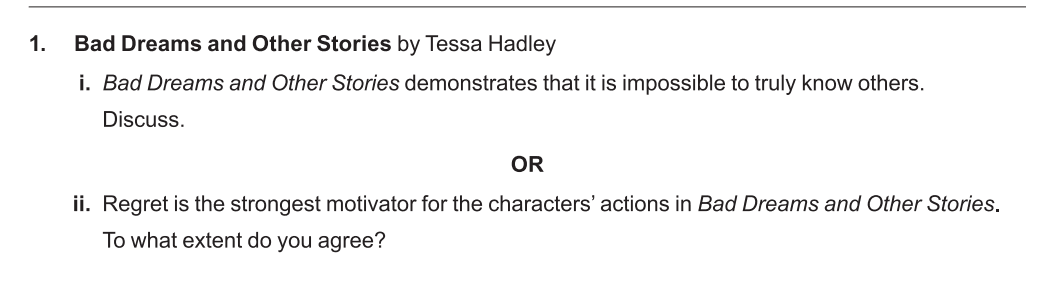
In the Text Response portion (Section A) of your exam and/or SACs, the essay prompts you’ll be given will be very similar to the prompts given to mainstream English students, but might be worded a little differently. For example, take a look at these examples from the 2024 exam - the prompts are similar, but not identical:
Prompts from the 2024 English exam:
Compared to the 2024 EAL exam:
Here’s another example from the 2024 English exam:

Compared to the 2024 EAL exam:

The Creative Writing (Section B) and Language Analysis (Section C) portions of the exam will also be very similar to the VCE English exam. The primary difference is that EAL students are expected to demonstrate:
‘Control of the conventions of the English language to convey meaning.’
While mainstream English students are expected to demonstrate:
‘Fluent expression through appropriate use of vocabulary and conventions of Standard Australian English.’
This means that perfecting your grammar, spelling and syntax isn’t enough - it is important, but it’s not enough to guarantee those high marks. You should focus just as much (if not more) on refining your ideas, your perspective and the meaning you want to convey through your writing.
4. Understanding What The Prompt Is Asking
When you’re sitting a SAC or exam, it’s super important that you understand what the prompt is asking you to do. Particularly when it comes to Text Response essay prompts, it’s easy to get confused by the different Question Words or Direction Words used on the exam.
a) Question Words
To know what sort of answer you are expected to give, you need to be familiar with question words. ‘Why’ and ‘How’ tend to be the most commonly used.
- Who - a particular person or group of people you’re being asked to focus on.
- What - this depends, but it might require you to discuss a theme, idea or concern explored in the text.
- When - the timeframe within which an issue or event occurred (date, day, etc.).
- Where - the location of an event, or the place within the text an idea is discussed.
- Why - the reasons for something, like the author’s intention behind writing their text.
- How - how an author uses language forms and features to explore an idea, character or setting in their text.
b) Direction Words
Not all prompts will use ‘Question Words’ - examiners often use ‘Direction Words’ in the essay prompts they give you. EAL is not the only subject that requires students to know their Direction words well, so it is definitely worthwhile learning these words to improve your performance.
- Analyse - breaking a topic down, unpacking how an author achieved an effect on a reader, and developing a perspective on how and why the author approached their text in the way they did.
- Describe - giving information about something within the text, without needing to analyse or share your opinion.
- Discuss - examining the topic from different perspectives, presenting evidence to support your discussion and reaching a conclusion.
- Explain - sharing information in your own words and elaborating on the ideas, themes or perspectives shared.
- Identify - finding information from the text or article and writing it down in the briefest way.
- List - conveying information, usually in note form.
- Summarise - retelling something in a succinct and concise way, in your own words.
- Support - finding evidence from the text to justify a statement or opinion.
5. English Fluency and Proficiency
Since improving your proficiency in English is important for success in EAL, here are some tips to help you work on your writing skills.
a) Consider the importance of sentence structure, syntax and grammar
Knowing your sentence structure and grammar is so important! Without a solid understanding of how your ideas are supposed to be structured, grammatical errors can easily be made which will prevent you from articulating your ideas in the clearest way possible.
If your ideas aren’t expressed clearly, your assessor/examiner will have a hard time understanding what you’re trying to say, and that can result in lower marks for you.
This blog breaks down syntax, clauses and sentence structures. It's designed for students doing VCE English Language (a subject focused on linguistics) so it might be a bit advanced, but you might be able to pick up some tips and tricks that will strengthen your writing.
b) To expand your vocabulary: read, read, read!
While it’s sometimes helpful to memorise words from glossaries found on the internet, it’s not the most effective way to improve your vocabulary. In fact, learning words from a glossary or dictionary can often lead to students misusing terms due to their misinterpretation of these new words.
The best way to upgrade your vocabulary and your general understanding of the conventions of the English language is to read! It’s one thing to learn new words, but it’s another thing to see how they’re used in context. Whether you prefer fantasy novels, romance, sci-fi, autobiographies, YA fiction or non-fiction history books, the more you read, the better your understanding of English vocabulary, sentence structure and syntax will be. You don’t have to limit yourself to your school texts!
TIP: Reading EAL resources also counts - not only will you get in more reading practice, but you’ll learn helpful EAL content along the way.
For some sentence starters to broaden your vocabulary in Language Analysis, check out this blog.
c) Develop a go-to essay structure
Once you have a go-to formula for structuring your essays, the writing process gets a whole lot easier. Your teacher might have taught you acronyms like PEEL or TEEL - but you should find what works for you. If you know how to organise your ideas in a coherent way, you’ll take a lot of the guesswork out of the equation, and your examiners will be able to follow your essays easily.
For more advice on how to structure, plan and improve your essays, check out these resources:
- 5 Tips for a mic drop worthy essay conclusion
- How I Do Essay Plans (A Real-Life Example!)
- How To Embed Quotes in Your Essay Like a Boss
- How To Structure an A+ English Essay
- How To Write an A+ Argument Analysis Essay.
- What Does Improving Your English Really Look Like?
- Why PEEL + TEEL Aren’t the Only Essay Structures You Should Use
d) Go easy on yourself: the most important thing is your ideas
We said this earlier, but it’s worth repeating. The ideas, perspectives and insights you have to share are just as (if not more) important than your ability to write in perfect English. Although you should definitely spend some time refining your fluency in English, don’t allow this to become your sole focus. Some students prioritise working on their English proficiency over building their knowledge and understanding of the core concepts of the EAL course or their text, but writing essays in perfect English doesn’t mean much if you don’t have good insights or analysis to share.
If you have a good understanding of the text you’re studying for Text Response, you know how to analyse a text in Language Analysis, and you have strong ideas to convey through your Creative Writing or Oral Presentation - you’re already on the right track.
6. Resources
Doing this study all by yourself can be rather daunting, so we've got your back. We specialise in supporting students by creating helpful videos, study guides and ebooks on a wide range of topics. Here are some just to get you started:
YouTube
We create general Text Response advice videos like this:
We also cover general Creative Writing tips like this:
And show you how to analyse Language Analysis articles, like this one from a past VCAA exam:
Check out our entire YouTube channel (and don't forget to subscribe for regular new videos!).
eBooks
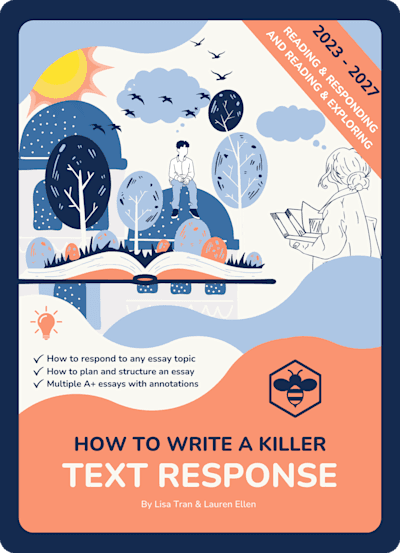
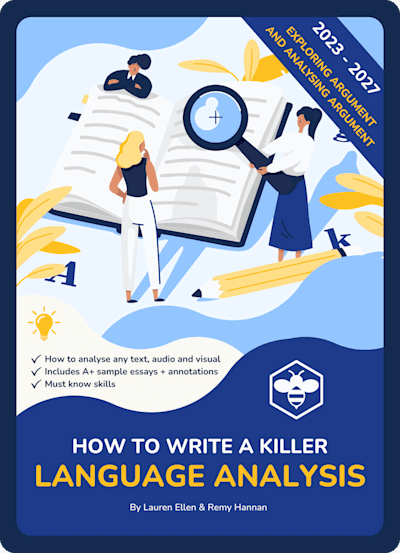
We’ve also written a range of eBooks - our most in-depth resources, where we unpack everything you need to know to ace EAL. Check out How To Write A Killer Text Response and How To Write A Killer Language Analysis as your starting point.
Blogs
We have created a range of blog posts on a variety of English and EAL areas, texts and study strategies. All of the tips we provide apply to both EAL and VCE English!
We teach core criteria such as:
As well as text-specific study guides like:
Oedipus the King: Ultimate Guide to Themes, Symbols & Structure
Plus EAL-specific blogs like:
The Keys to English Proficiency and Fluency
These blogs below are based on the old EAL study design, which involved a ‘listening’ task that no longer exists, but they still have plenty of useful tips that you can use - particularly when you’re analysing an audio or audio-visual text for your Unit 3 Text Response, or the Language Analysis AoS.
- How To Take Speedy Notes During Listening Component of VCE EAL Exam
- Tips on EAL Listening
- EAL Listening Practice
- Exam Tips From VCE EAL Examination Reports
Here are some other blogs you’ll find helpful:
- The Ultimate Guide to VCE Creative Writing
- The Ultimate Guide to VCE Language Analysis
- The Ultimate Guide to VCE Oral Presentations
- The Ultimate Guide to VCE Text Response
- Formal Versus Informal Language
- How To Effectively Annotate Your Texts In VCE
- How To Overcome The Mid-Exam Crisis
- How To Survive VCE - Motivation And How To Approach VCE
- Sentence Structures And Syntax Explained
- Show, Don’t Tell
- Simple Language, Complex Ideas
- The Importance of the Introduction
- What Does Improving Your English Really Look Like?
- What Teachers Look For In VCE English Students
- Why Using Big Words Can Make You Look Dumber