This blog post has been revamped and updated for the latest 2023-2027 English study design.
Contents
- What Is Creative Writing?
a) Mentor Texts
b) Your Creative Piece
c) Written Commentary/Annotations - What Will Your SAC and Exam Look Like?
- Criteria & Expectations for Creative Writing
- Literary Elements (Themes, Symbols, Language, Characterisation)
- Sample A+ Creative Responses
- School Assessed Coursework (SAC), Exams, Allocated Marks
- How to Prepare for your Creative Writing SAC and Exam
Key Terms You Need To Know
Before we jump into things, here are a few key terms you need to know in order to navigate this blog (and Area of Study) like a pro:
- Form: the text type (e.g. a short story, a poem, or a speech)
- Mode: the way the text is presented or communicated - audio, digital, written, spoken or visual (or a combination of these).
- Style: the way an author uses language to convey a message (e.g. word choice, tone or voice).
- Idea: the topics an author writes about and the concerns, opinions or messages they convey about that topic (e.g. Country, land, place, belonging, migration, environmentalism).
Since there’s an overlap between ‘form’ and ‘mode’ (a speech is designed to be listened to, while a short story is usually designed to be read), we’ll sometimes use the terms interchangeably.
1. What Is Creative Writing?
Creative Writing is officially known as ‘Crafting Texts’ in Year 11, and ‘Creating Texts’ in Year 12. We’ll use the term Creative Writing (or even just Creative) throughout the blog to keep things simple.
For Creative Writing, you’ll be asked to read a selection of short mentor texts that model what effective writing looks like. What ties the mentor texts together is that they all circle around a central set of ideas. Your job is to read those texts closely and pull apart the ways each writer approaches the same big idea in their own style and form. You’ll then produce your own original Creative piece that responds to and expands on those ideas, showing your perspective on those topics. You will also produce a written commentary (mainstream English) or a set of annotations (EAL).
These are the 3 key components you need to understand to nail your Creative, so let’s tackle each of these separately below:
a) Mentor Texts
b) Your Creative Piece
c) Written Commentary/Annotations
a) Mentor Texts: What are they and how will they be selected?
In Year 11, your school or teacher will decide on a central idea for the class to explore, and they’ll choose a selection of mentor texts that link back to that idea.
In Year 12, things get a bit more standardised. There are four key Frameworks of Ideas:
- Writing about Country
- Writing about Protest
- Writing about Personal Journeys
- Writing about Play
Your teacher will choose ONE of these Thematic Frameworks for you to work on.
Each of these Frameworks has five assigned mentor texts that explore the key ideas behind it. For example, if you’re working on the Writing about Country Framework, the mentor texts you read might all link back to the ideas of place, land, environment and belonging. You’ll read or watch most (if not all) of the mentor texts for your Framework together in class. VCAA says you’ll study at least three of the mentor texts in depth, but many teachers will expect you to read them all.
The texts that have been chosen range from short stories to speeches, monologues, essays, podcasts, poetry/songs, feature articles, memoirs or biographies. This variety allows you to see how different authors can approach the same set of ideas in different ways, through different forms and styles.
In class, your teacher will encourage you to make connections between the ideas explored in the mentor texts and the experiences and events in your own lives, so that when it’s time for you to write, you’ll both have inspiration and a personal angle to draw from.
b) Your Creative Piece: What will it look like?
Similar to the mentor texts, the Creative piece you produce can also range in form, from short stories, to reflective think pieces, to persuasive opinion essays, or anything in between (excluding works of poetry or verse). Whatever form it takes, it has to connect back to the ideas raised in your mentor texts. There’s quite a bit you need to consider when writing your Creative, so make sure to pay extra attention as you read on. In Sections 2, 3 & 4 below, we’ll walk you through the criteria & literary elements that need to be incorporated in your written piece, before showing you two sample Creative excerpts in Section 5 to give you an idea of the type of writing you might produce.
c) Written Commentary/Annotations: What are they and what will they look like?
After writing your Creative, you’ll then do a Written Explanation reflecting on the choices you made while constructing your piece.
- Mainstream English students will do this through a written commentary that analyses your use of language features.
- EAL students will produce a set of annotations that comment on your work
In your Written Explanation, you will reference your mentor texts, explaining how you drew inspiration from the texts you studied in class and how your piece connects with the ideas of your Framework.
As far as we know, you will not be required to do a Written Explanation in the final English/EAL exam. While VCAA hasn’t explicitly ruled it out, past VCE exams suggest that Written Explanations are most likely only assessed by your teacher as part of your SAC.
We won’t go into depth on the Written Explanation in this blog, as we have a detailed overview of it over on our Written Explanation - Explained blog post.
2. What Will Your SAC and Exam Look Like?
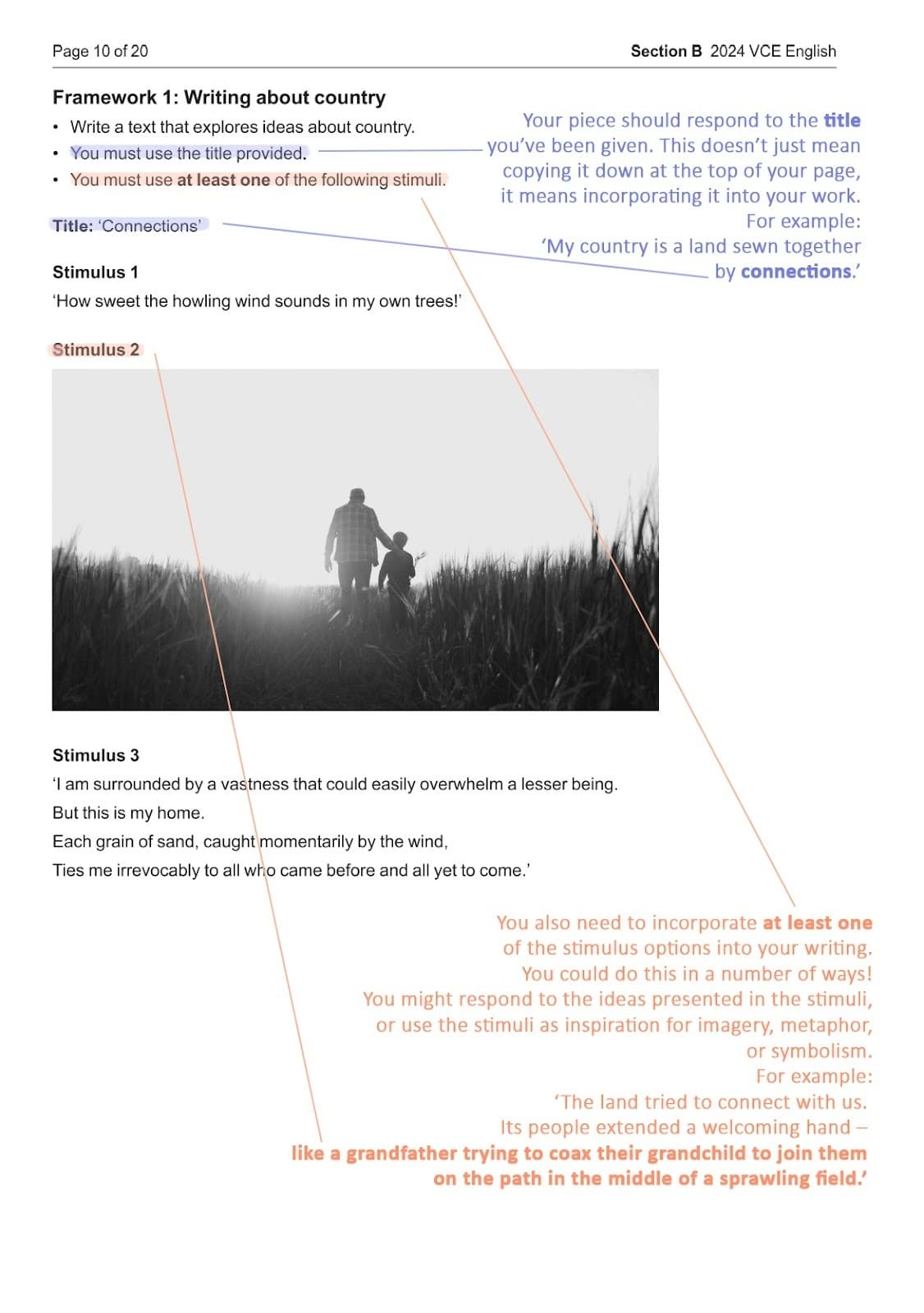
You’ll be given a collection of stimuli that reference the same set of ideas explored in your Framework. You’ll also be given a title for your piece. You won’t have seen the stimuli before, and they won’t be from the mentor texts you studied.
You’ll produce a piece of writing that responds to this set of ideas in your own way, building on the title and stimuli you’ve been given. The Creative piece you produce will be based on the stimuli, not the mentor texts themselves - but because the stimuli link back to the same ideas you explored in your mentor texts, you’ll draw from your knowledge of the topics you analysed in class to write your piece.
The example we’ve used here is from the 2024 VCE English Exam and Examiner’s report.
3. Criteria & Expectations for Creative Writing
Before you start writing, it’s essential that you read and analyse your mentor texts. These texts were chosen because they’re good examples of the kinds of Creative Writing you’re being asked to produce. They show you how different writers have structured their ideas, made deliberate language choices, and tailored their text for their intended audience. Look closely at how authors use form, language, audience, purpose and context (FLAPC) - you’ll pick up techniques and strategies to guide your own writing. The aim is to learn from the way these mentor texts have told a story, evoked emotion or created meaning, so that you can employ these features of effective and cohesive writing in your own work.
With a solid understanding of your texts, you can now focus on the criteria and elements that you need to incorporate into your Creative. Some schools may express the following points differently; however, they should all boil down to the same thing - what is necessary for Creative Writing.
a) Generate and develop ideas for your writing, drawing from the ideas explored in the mentor texts
Your writing needs to respond to the ideas, themes and concerns explored in your mentor texts. Think about the ways you can draw connections between the ideas explored in your mentor texts and your own personal experiences, memories or values; this is how you uncover the best material to write about.
For example, if you’re working on the Writing about Country Framework, you might think about your own connection to a particular place. What does home look and feel like to you?
b) Experiment with vocabulary, text structures and language features in your writing
You can get creative with the way you use language to convey meaning or create a compelling text. You can throw caution to the wind and abandon the strict and rigid rules that you have to follow when doing formal essay writing. Think about experimenting with word choices, employing the use of language techniques, or trying out different modes of writing. You can even experiment with non-standard conventions of language, like colloquial language or slang. For example, if you’re writing a journal entry, you’d be much more likely to use informal, colloquial language than if you were delivering a speech in front of your school.
The goal is to develop your own personal voice, convey your perspective of the world and develop your ability to evoke emotion through your work.
If you want to know more about the kinds of literary techniques and devices you can play with in your writing (otherwise known as metalanguage), check out our Metalanguage Word Bank for Books. We’re also going to take a look at Language in the Literary Elements section further down.
c) Create a text with a particular purpose, context and audience
VCAA doesn’t specify which form of writing you should produce, but they DO emphasise the importance of writing for a particular purpose, context and audience.
Consider Meyne Wyatt’s monologue from his play City of Gold - studied as a mentor text for the Writing about Protest Framework. It was written to be performed for an Australian audience (intended audience). Because of this, Wyatt draws on the topic of anti-Indigenous racism in Australia (context) to powerfully communicate the ongoing impact of oppression on Indigenous people (purpose).
The study design specifies that your Creative piece needs to have a clear purpose - to express, to reflect, to explain or to argue. And in your Written Explanation, you'll need to articulate what your purpose of was. For example:
‘The purpose of this piece of memoir is to reflect on my experiences of conflict, demonstrating that conflict can change us by forcing us to grow and develop new understandings of ourselves.’
You also need to consider the context and audience you’re writing for. If your purpose is to argue a position on climate change policy, a journal entry (whose audience would be only you) wouldn’t be nearly as effective as writing a letter to parliament or an opinion piece for a political newspaper.
Always be intentional about your writing, because remember, in your Written Explanation, you’ll have to explain the purpose of your work and why you’ve constructed it the way you did.
For more information on writing with purpose, check out:
- Interpreting Texts In VCE English: Context and Authorial Intent
- The Importance of Context
- What Is Authorial Intention and Why Is It Important?
These 3 blogs are were designed to help you consider authorial intent when writing Text Response essays, but you can apply these same ideas to your Creative writing!
Be sure to check out Written Explanation - Explained too, as we teach you the FLAPC strategy which will give you a deeper understanding of why purpose, context and audience are so important for your Creative.
d) Reflect and comment on your authorial choices, including the vocabulary, text structures and language features used in your writing
You’ll be asked to reflect on your work via your written commentary (mainstream English) or set of annotations (EAL). Your main job here is to reflect on your writing process and analyse your own text. This means thinking through the choices you made as an author, considering your use of language forms and features, and explaining how the purpose, context and audience of your work shaped your writing. You’ll also have to discuss how your work builds on and responds to the ideas explored in your mentor texts and the stimuli.
We show you how to do this in our Written Explanation - Explained blog post.
Now that you have a clearer understanding of the Criteria you need to meet, let’s take a look at some of the Literary Elements you can actually incorporate into your Creative piece to strengthen your writing.
4. Literary Elements (Themes, Symbols, Language, Characterisation)
Literary elements are the building blocks that help shape an effective Creative piece. Depending on the form you choose, some elements will naturally play a bigger role than others, but most strong Creative Writing pieces draw on a combination of them to add depth, clarity and impact. These elements help make sure your writing lines up with what VCE expects from this Area of Study. The form and topic of your text will influence the literary elements you choose to consider, but remember that your work basically needs to do two key things:
1. To engage meaningfully with the themes explored in your Framework (in particular, you need to respond to the stimuli you’re given).
2. To create a unique, original piece of writing that reflects your ability to communicate your creative and critical thinking through your work.
Themes
Themes are the key ideas and issues that are relevant to the storyline of a text. You can identify themes by labelling the main areas of meaning within a text and thinking about the messages that emerge throughout the text. To build your understanding of themes explored in your mentor texts and to evaluate the themes of your own Creative, consider the following questions:
- What is the text really about, beyond superficial elements like plot and character?
- What is the text saying to its reader?
- What are the core idea(s) or issue(s) within the text?
- What idea(s) or issue(s) do the message(s) of the text correspond with?
As an example, in The Simpsons, we could say that the themes include love and family, neighbourliness and social class. From episode to episode, The Simpsons comments on these different issues. For example, Marge and Homer’s relationship, with its domestic setting and marital ups and downs, is a core aspect of the Simpsons household. Likewise, family is a major component of not only the Simpsons themselves, but also the broader Springfield community. The interactions between parents and children is evident on Evergreen Terrace with the Simpsons and the Flanders families, as well as in other settings such as Springfield Elementary School (where even an adult Principal Skinner is seen through his relationship with his elderly mother). These broad areas can be identified as the key thematic concerns of the series because each episode centres around these ideas.
Since you’re expected to write a piece that responds to, or builds on, the themes explored in your Framework, it’s important you consider the ideas, issues and messages you’re trying to share through your writing.
Symbolism
Check out our blog post here to read more about the difference between themes, symbols and motifs.
A symbol can be defined as a thing that represents something else. Symbols are typically material objects that hold a deeper meaning. For example, in Harry Potter, Harry’s scar is a symbol of his difficult childhood. Because Harry’s scar causes him pain in Voldemort’s presence, it can also be said that the scar is symbolic of the connection forged between Harry and Voldemort when Voldemort's attempt to kill Harry failed. As this example suggests, symbols are often associated with the text’s themes - in this case, Harry’s scar relates to the themes of childhood and death.
The key with symbolism is to connect a particular theme or idea to a physical object. For example, the theme of grief could be portrayed through a photo of someone who has died. Likewise, the theme of change might be represented by a ticking clock, while a character’s clothing could be a symbol of their wealth or status.
For a closer look into the way symbols, motifs and textual devices can be used to explore different themes in a text, read Oedipus the King: Ultimate Guide to Themes, Symbols & Structure.
Language
Language is a broad term that covers all the choices a writer makes in how they convey their ideas - from the words and phrases they use, to the techniques and devices such metaphors, anecdotes or imagery (in otherwords, metalanguage).
The way in which a piece of writing is expressed can be defined as the style or tone of a text, or the voice used by the author. The words and phrasing chosen by a writer determine how ideas are communicated, and language devices and features can create depth and meaning. Effective language will be appropriate for the world of the text and contribute to the writing in a meaningful way.
Imagine if Harry Potter was written in an informal, Australian style of language. It would hardly suit the magical, whimsical world of the text, right? Similarly, if The Simpsons sounded like a Shakespeare play, it certainly wouldn’t be as entertaining. For this reason, the way in which you write your Creative should align with its plotline, themes and character(s).
Language also includes Dialogue - an exchange of conversation between characters. Dialogue is often used to provide context to a text, to develop its storyline or to offer direct insight into a character’s thoughts, feelings and personality.
In Of Mice and Men, the dialogue between George and Lennie establishes both their working class status as labourers in the 1930s, and the tenderness in their relationship. For example:
Lennie: ‘George wun’t go away and leave me. I know George wun’t do that.’
George: ‘No, Lennie. I ain’t mad. I never been mad, an’ I ain’t now. That’s a thing I want ya to know.’
Their speech patterns convey their social background, while their words show the depth of their bond.
There are a number of ways in which a piece of writing can be articulated, and you should consider the nature of your piece when deciding what type of language is most appropriate for your Creative; a persuasive opinion letter written to a politician will use different language devices than a reflective memoir about your childhood experiences.
Characterisation
As we know, characters are fictionalised people within the world of a Creative text. Whether you’re working on a short story, or you’re writing a persuasive speech from the perspective of a fictional character - you might like to consider the role of characterisation in your work.
Almost an entire century ago, the English writer E. M. Forster famously introduced the concept of flat and round characters in his 1927 book, Aspects of the Novel. According to Forster, flat characters can be defined by a single characteristic; in other words, they are two-dimensional. To return to our example of The Simpsons, the characters could arguably all be defined as flat; Homer is characterised as a slob, Flanders is defined by his Christian faith, Lisa is stereotyped as the teacher’s pet, and Bart is portrayed as rebellious. We can define all of these characters as flat because they are labelled to the audience in these two-dimensional ways.
In contrast to this, round characters have multiple characteristics, which bring them closer to seeming like real, human figures. The personality of these characters extends beyond a single attribute. In Harry Potter; Harry is a round character because of how much we learn about him over the course of the series. For example, we find out about Harry’s difficult childhood, his personal challenges, his love interests, and we see his personality grow from book to book.
Whether the characters of your Creative are flat or round will depend on their involvement within, and importance to, the storyline of your piece. Generally speaking, if you’re developing any characters in your writing, you should aim for the central character(s) to be round, because multi-dimensional figures are typically more realistic, believable and engaging to read about. In turn, you’ll be able to better demonstrate your writing skills and understanding of the text through these characters.
5. Sample A+ Creative Responses
Since your Creative piece could take a range of forms, we’ve included excerpts from two sample texts below to give you an idea of the types of Creative Writing you can experiment with in this Area of Study.
Here’s an excerpt from a short story written by Isabella, 46 study scorer, for the Writing about Personal Journeys Framework:
It has been hours since Sonia arrived, and the sun now hangs low in an orange sky, unobstructed by clouds. Water slips over the mountain’s edge, almost resisting in some way against the stones, yet inevitably collapsing to the pool below, pulled by some uncontrollable force. It is strangely quiet, providing an uncomfortable sort of peace.
Her throat still aches from sobbing, but she appreciates finding the strength to be here. The ducks have returned to the pool but are forced in all directions by the gushing water. It ripples and retracts, unsteadies them, but eventually they find their way, settling into a graceful choreography.
Placing a hand on her chest, she tries to find her heartbeat, but it only feels hollow. She remembers her backpack tucked under a shrub, and pulls out the urn. It is with regret that she could not do it sooner that Sonia scatters her mother’s ashes into the waterfall, releasing her soul onto the landscape so it may persist in all the living entities and light and wind and rain surrounding her. Sonia tucks the urn back in her backpack, a weight lifting from her shoulders, but it offers no solace at all. She turns to leave, gazing for the last time at the waterfall, its unbroken cadence a steady, resilient current against the instability and impermanence of life.
Here’s an excerpt from a persuasive speech written by Ellie, 50 study scorer, for the Writing about Protest framework:
Good afternoon everyone. For any new faces joining us today, welcome to the Student Climate Action Club. First up on the agenda today, I’d like to address the upcoming Melbourne wide student strike for climate action. Up until this point, the message being directed at you, by your parents, your school, your politicians, has been fairly concise: do not attend. I am here to give you a different one. Our attendance at this strike is imperative. Not because we want to be there, but because we have to be. The climate crisis has escalated, but the action by our leaders does not reflect nearly enough the desperation of the situation. We have no choice but to raise our voices.
We are in the midst of a catastrophe, and they are telling us to go to school as if it is business as usual. But we know that it is not. We know that our planet is propelling towards the point of no return. We know that it is because of their neglect towards this issue that we need to protest at all. Social progress can only be achieved when we resist normality. Normality is comforting, but we can not be comfortable with the state of our climate, nor the lack of action being taken to resolve it. It is evident that the solutions to the impending cataclysm require us to uproot life as we know it and change the way our society operates. Convention is the enemy of evolution. Our participation in this strike in lieu of attending school as normal communicates a broader message: that we will not allow convention to stand in the way of the necessary action. I understand that to leave school to rally, in spite of instructions from the adults in your life, is a difficult choice to make. But just because something is easy does not mean it is right. And just because something is difficult does not mean that it is wrong. The participation of every single one of you is crucial. The uprising of one person can make a difference, no matter how powerful the forces you revolt against. Because the resistance of one person sends the message that just because something has been socially accepted, does not make it acceptable.
6. School Assessed Coursework (SAC), Exams, Allocated Marks
In Years 11 and 12, you’ll most likely tackle Creative Writing in Term 2 - your school may do it at a different time though, so double check with your teacher.
Since your Year 11 results don’t count towards your final Study Score, below is a breakdown of the marks allocated to your Creative Writing SAC in Year 12.
For mainstream English students:
- Unit 3:
- 40 marks (for your Creative piece)
- 20 marks (for your Written Commentary)
This means that in total, 60% of your School Assessed Score for Unit 3 comes from your Creative Writing SAC(s), with 40% of your grade coming from your Creative piece, and 20% from your written commentary.
For EAL students:
- Unit 3:
- 40 marks (for your Creative piece)
- 10 marks (for your set of annotations)
This means that for EAL students, 50% of your School Assessed Score for Unit 3 comes from your Creative Writing SAC(s), with 40% of your grade coming from your Creative piece, and 10% from a set of annotations reflecting on your text.
The time allocated to your SAC is school-dependent. Often, schools use one or two class periods to conduct your SAC, depending on how long each of your periods lasts. VCAA suggests writing 700 to 900 words for your Creative piece, but your teachers could ask you to write two shorter texts, around 400 to 450 words each. You should aim to write around 400 words on your written commentaries (or 250 words for EAL students producing a set of annotations). Keep in mind that it’s about quality, not quantity, and for anything internally marked, it’s important to keep your teacher’s preferences in mind!
In your exam, you get a whopping total of 3 hours to write 3 responses (Text Response, Creative and Language Analysis). The general suggestion is to spend 60 minutes on Creative Writing, but it is up to you exactly how much time you decide to dedicate to this section of the exam. Each section of the exam is worth a total of 20 marks.
7. How to Prepare for Your Creative Writing SAC and Exam
It doesn’t matter if you’re naturally gifted at English or if you’re the most skilled creative writer in the world - if you don’t prepare well enough for your exams, you won’t be able to reach your potential! That being said, different brains work differently, and it’s important that you put a bit of time into figuring out what study strategies work best for you. Here are our top strategies for Creative Writing preparation that can be done at any time of year (including holidays - see How To Recharge Your Motivation Over the School Holidays for more tips):
a) Reread (or rewatch) your mentor texts
After all the learning and discussion you’ve had with your teacher and peers, you should now have developed a solid foundation of knowledge. Reviewing your mentor texts will help you refresh your memory and spot things you didn’t notice before. One of the best ways to improve your Creative Writing ability is to take inspiration from the way other authors have constructed their texts; when you read another author's work, it allows you to figure out what works - and what doesn’t.
b) Develop a range of ideas you can draw from in your writing
Think about the ideas, themes and concerns explored by your mentor texts. What resonates with you? Do you have a perspective to share? Are there experiences or events in your own life you can draw from and connect to the ideas of your Framework?
In your SAC and final exam, you’ll be given a collection of stimuli to respond to, and you need to make sure that your writing incorporates the prompts you’ve been given. So rather than preparing one piece of writing that you plan to memorise and replicate on every SAC or exam, you should aim to develop a range of ideas for your writing that relate to the themes explored in your mentor texts. The more ideas you have to draw from going into an exam, the better.
Start with your personal experiences, memories and values (think about what relates to your Framework) and then spend some time developing a list of ideas for your work.
If coming up with creative ideas for your writing is a struggle, don’t worry! Check out our video on Tips and Tricks for VCE English Creative Writing for a simple strategy to help get you started.
c) Read and watch our resources
Doing this study all by yourself can be rather daunting, so we've got your back. We specialise in supporting VCE English by creating helpful videos, study guides and ebooks. Here are some just to get you started:
YouTube Videos
We create general Creative Writing videos, like this one that explains exactly how to write a good Creative piece (breaking down the meaning behind the elusive ‘show, don’t tell’ phrase we’ve all heard our teachers use!):
We also create videos that unpack all of the Thematic Frameworks, analysing sample Creative pieces to give you some inspiration:
If that’s not enough, we have videos that offer general study advice in the lead up to your SACs and VCE exams, including tips and tricks that can help you prepare for the Creative Writing task!:
Check out our entire YouTube channel (and don't forget to subscribe for regular new videos!).
Study Guides
Our awesome team of English high-achievers have written up study guides to help you tackle VCE Creative Writing. Here are some of the topics we’ve covered so far:
- 5-Step Recipe for Creative Writing
- How To Improve VCE Creative Writing Using Pop Song Techniques
- How To Write An Emotional Creative Response For VCE English
- VCE Creative Writing: How To Structure Your Story
- VCE English Unit 3, Areas of Study 2: Creating Texts - What Is It?
We also have resources written for the old study design (so they’re somewhat out of date), but they still include some handy tips and tricks on improving your Creative Writing abilities, so they’re worth a read!
- "Creative Response to Text" Ideas
- How To Achieve A+ in Creative Writing (Reading and Creating)
- Reading My 10/10 Marked CREATIVE GAT Essay
- VCE Creative Response to Runaway by Alice Munro
And while these blogs below have been written with Text Response in mind, they provide some incredibly useful insights on context, purpose, setting and literary elements that can be applied to the Creative Writing process:
- Interpreting Texts In VCE English: Context And Authorial Intention
- Oedipus the King: Ultimate Guide To Themes, Symbols & Structure
- The Importance of Context in VCE Literature (and English & EAL)
- Understanding the Symbolic Nature of Setting in The Erratics
- What Is Authorial Intent In VCE English And Why Is It Important?
d) Get your hands on a range of stimuli or prompts
Your teacher might give you a list of stimulus prompts to practise with before your SAC. If they haven’t, don’t be afraid to ask. Otherwise, try the VCAA English exam page; since the current study design is relatively new, it’s only the exams from 2024 onwards that are up to date.
The more stimulus examples you can engage with, the more material you have to inspire your Creative Writing, and the more prepared you’ll be for whatever the exam will throw at you!
e) Practise your Creative Writing
Yes, sad, but it’s a fact: practice makes perfect. Writers only get better by actually writing. Writing practice texts helps you develop the skills and thinking processes that allow you to respond to the stimuli you’ve been given, express yourself creatively, and construct compelling texts that engage your reader. Timing yourself and writing against the clock will also help you develop ideas faster and write quicker - something that is a major problem for many students.
Check out our video that breaks down four key tips for improving your Creative Writing skills:
f) Get feedback, review and improve your writing
It’s not enough to just write an anthology of sample Creative pieces if you’re not working on improving your skills each time. Letting someone read your Creative Writing is incredibly daunting, we know - but getting feedback on your work is so important. It gives you the opportunity to review your writing and develop your skills, to figure out what worked and what didn’t. Show your work to your friends, your family, your teachers, your tutors! This doesn’t mean you have to take every piece of advice on board, but when you get feedback from others, your skills will improve much faster.