
Sunset Boulevard A+ Essay Topic Breakdown
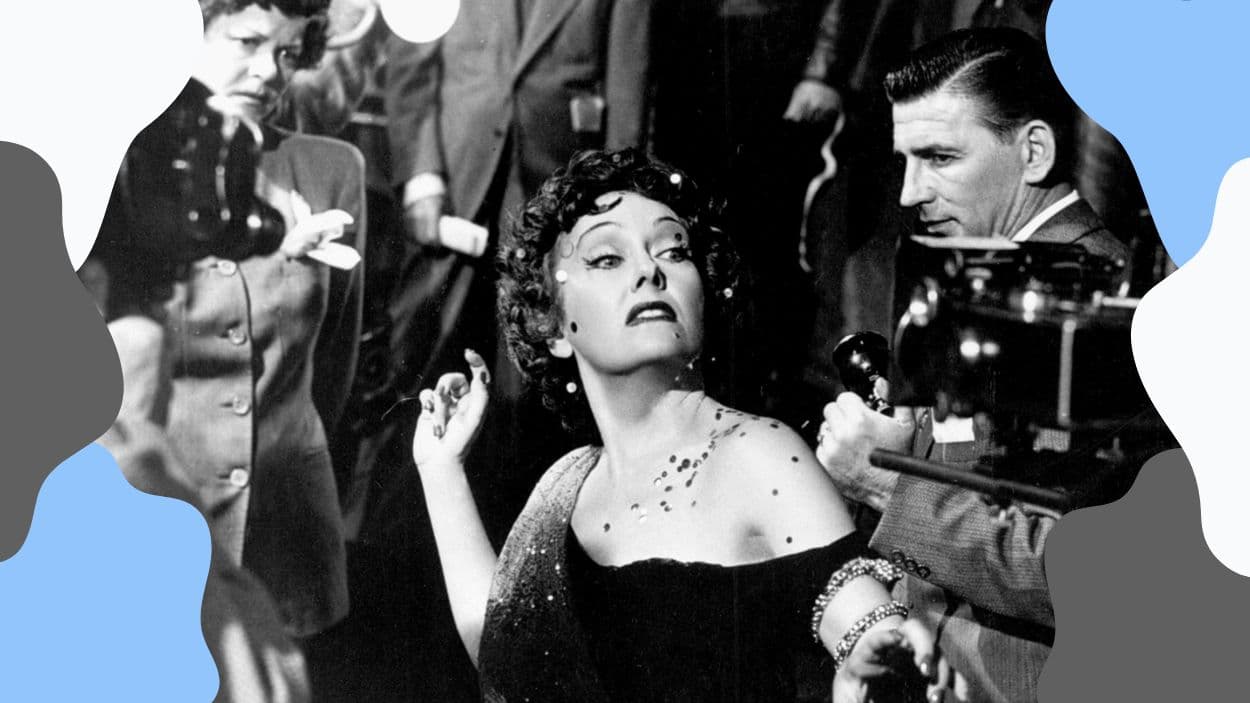
Sunset Boulevard by Billy Wilder is usually studied in the Australian curriculum as a Text Response. For a detailed guide on Text Response, check out our Ultimate Guide to VCE Text Response.
Here, we’ll be breaking down a Sunset Boulevard essay topic using LSG’s THINK and EXECUTE strategy, a technique to help you write better VCE essays. If you’re unfamiliar with this strategy, you can learn about it in our How To Write A Killer Text Response study guide.
Within the THINK strategy, we have 3 steps, or ABC. These ABC components are:
Step 1: Analyse
Step 2: Brainstorm
Step 3: Create a Plan
Let’s get into it!
The Prompt:
Sunset Boulevard shows that in a town full of stories, it can be difficult to distinguish between dreams and reality. Discuss.
THINK
Step 1: Analyse
This is a theme-based prompt that focuses on the theme of dreams and reality.
The phrase ‘difficult to distinguish’ gives me a big indicator of what my essay should revolve out. It hints that dreams and reality are not just opposites or two completely separate concepts. I would need to examine how dreams and reality clash but also how they are intertwined, revealing Wilder’s broader critique of Hollywood.
This is a discuss prompt, therefore, I need to consider both sides of the argument.
Step 2: Brainstorm
Coming up with synonyms for key words in the prompt helps me prevent repetition of the same word in my writing:
- Town full of stories - world of spectacle, delusion, hollywood machine, dream factory
- Dreams - aspirations, pursuits, wants, ambitions, fantasy, illusion
- Reality - truth, authenticity, real world
Key scenes that are relevant and can be used in my essay:
- Norma watching her past silent films to avoid facing reality
- Joe’s pool scene where his chase for his dreams resulted in his demise
- Betty’s and Joe’s walk down the town full of stories
- Opening scene with the gutter to symbolise how some dreams are unattainable and thrown away
Who is involved in blurring the line between dreams and reality?
- Hollywood forces people to worship/idolise their past lives and live the remainder of theirs in pursuit of unattainable youth and glory.
- 1950’s audience (the true consumers of the movies at the time) had very rigid and glorified views of what Hollywood was.
CAMELSD I remember:
- Camera angles - low angle shot of Joe’s body, high angle shot of the gutter, mid shots between conversations
- Acting - Norma’s unhinged and controlling behaviour, possessiveness of Joe, her behaviour at the end when she is in front of all the cameras again
- Mise-en-scène - swarm of homicide squad to represent the reality behind chasing fame, Norma performing her follies that keeps her trapped in her past
- Editing - beauty montage
- Lighting - bright lighting (high key) can symbolise dreams whereas dark lighting (lowkey/chiaroscuro)can symbolise reality
- Sound - ominous background noise, joyful music from the New Year’s party
- Dialogue - Betty says that the town is ‘all cardboard, all hollow, all phony, all done with mirrors’ revealing the fabrication of Hollywood
Key ideas:
- Dreams and reality can be intertwined under Hollywood pressures
- It can be hard to let go of an era in which an individual thrived in
- Chasing one’s dream can cause an individual to be unaware of the major flaws within the entertainment industry
By this point, I have a lot of ideas but they’re all jumbled and not necessarily organised in a way that’ll make them easy for me to use. I know I ultimately need 3 body paragraphs, with 3 distinct ideas. I asked myself the following questions to help me sift through my brainstorm and group together relevant ideas:
1) Why can't Norma see the reality that it is an industry reliant on sound and youth?
2) How can individuals separate dreams and reality?
3) Who is responsible for individuals being unable to distinguish between dreams and reality?
Each of these questions (and it’s answers) can form the basis of each of my body paragraphs.
Step 3: Create a Plan
Contention: Billy Wilder’s cynical film noir Sunset Boulevard portrays Hollywood’s tendencies to blur the line between dreams and reality for its indentured servants.
Paragraph 1: Sunset Boulevard warns that in a town built on fabricated dreams, individuals are marooned in the delusional state of the past, trapping them in a dream that eclipses reality.
- Talk about Norma’s delusions and attachment to her past and how this has prevented her from realising reality, answering Q1.
Paragraph 2: Wilder commends ambition with awareness as a necessity in an illusory world, in that it acts as a deterrent to its superficiality.
- Discuss how awareness of the industry or other factors can prevent individuals from being consumed by Hollywood’s illusions, answering Q2 and offering an opposing argument.
Paragraph 3: Overall, Wilder condemns the Hollywood industry and consumers for masking the underlying decay with its noxious allure and glorified stories, to keep the boundaries between performance and reality irrevocably blurred.
- Focus on Hollywood’s ideals and 1950s audiences to draw on how they influenced the lifestyles of past and upcoming stars who are chasing their dreams, answering Q3.
EXECUTE
Now it is time to write the essay!
As the silent film era fades, the new Golden Age of Hollywood, compounded by synchronised sound and the advent of television, brings unbeknownst pressures and obstacles for those pursuing the elusive, quintessential Hollywood dream (1). Hence, Billy Wilder’s cynical film noir (2) Sunset Boulevard portrays Hollywood’s tendencies to blur the line between dreams and reality for its indentured servants (3). Wilder posits how Hollywood’s grandeur fosters self-delusion, trapping forgotten stars in a cycle of intransigence. Yet, Wilder also praises those who remain vigilant to its fabricated ideals while daring to dream. Ultimately, Wilder blames the industry for manufacturing the semblance of prosperity and fame, luring individuals into chasing an unrealistic dream (4).
Annotations
(1) You want to start by providing the context behind the film, aka explore the overarching reason or setting for the character’s actions and/or consequences. It is important to draw the examiner’s attention with your opening line.
(2) Remember to include the text type/genre, in this case it is a film noir. Add an adjective beforehand too such as satirical or cynical as it will give the examiner more detail on how you interpret or understand the film. It helps establish Wilder’s overall attitude/tone towards Hollywood.
(3) Following my context sentence, I’ve intentionally included a concise sentence that links to the prompt ‘Sunset Boulevard shows that in a town full of stories, it can be difficult to distinguish between dreams and reality. Discuss.’ I did this to show examiners that I have focused on answering the prompt from the onset rather than reciting the film and giving too much background information. Keeping it concise establishes what my essay will be about without giving too much analysis that will be explored later on.
(4) I briefly introduce my main ideas (at least three) that I will discuss later as this signposts to the reader what my main arguments are as well as the structure of my essay since I have listed them in order. It ensures that every body paragraph links back to my contention. Using transition words such as furthermore, moreover, however to improve the flow and clarity of your writing.
Billy Wilder’s Sunset Boulevard warns (5) that in a town built on fabricated dreams, individuals are marooned in the delusional state of the past, trapping them in a dream that eclipses reality (6). Amidst the elusive Hollywood dream, the devolution of revered stars into unhinged, tragic caricatures exposes how the dream factory blurs the line between truth and delusion (7). The closeups (8) of the ‘run down’ (9) and derelict palazzo are reminiscent of Miss Havisham’s house in Great Expectations (10), alluding to how, like the vindictive Miss Havisham, Norma too embodies such an archetype who is living in the past, insinuating the haunting decay that emerges when dreams mesh with reality. Through this intertextuality (11), Wilder hints (12) towards Norma’s incapacity to recognise reality as her prestigious past, captured through the wide shot of portraits of her ‘celluloid self’, lingers in every shadowed corner of her mansion, showcasing how difficult it is for deluded individuals to discern that others do not perceive fantasy the same way they do. Moreover, Wilder slyly employs celestial imagery to expose Hollywood’s dramatised and staged spectacles that merge illusion with reality**(13).** The hyperbolic word play (14) of a reunion with DeMille as a ‘great conjunction’ alludes to how the ‘greatest stars’ are trapped in their own stories of eternal glamour, resorting to astrological compatibility to sustain a once shimmering yet materialistic dream, without confronting reality (15). Similarly, Norma’s ‘follies’ serve to allay her crippling fear of obscurity, as she retreats into her illusions to preserve the remnants of her former glory. Wilder posits (16) that an individual's futile and desperate effort to imitate the past functions as a fragile shield against the confronting truth of their obsolescence. Ultimately, Wilder fervently captures how when dreams become the only reality, individuals cease to exist beyond performance (17).
Annotations
(5) An author’s views and values shape their writing, so it’s important to address authorial intent - in this case, what he wants us to believe/feel about Hollywood’s exploitation. I have used the word ‘warns’ over a simple ‘highlights’ or ‘demonstrates’ to tell the examiner what Wilder is trying to convey.
(6) An easy way to start your body paragraph is “[Author]’s [name of text] warns/demonstrates/reveals…” You should never include a character’s name in your topic sentence - just be your overall idea. This is because you want to focus on answering the prompt and theme rather than focusing on a character which limits what you can analyse. It shows the examiner that you can recognise Wilder’s message and not just plot.
(7) Include a lead in/intro to your first piece of evidence. It also acts as a way to expand on your topic sentence. Here by writing ‘the devolution of revered stars’, I hint towards discussing a character who represents this, in this case it’s Norma.
(8) Because it is a film analysis, make sure to include film techniques! The number one mistake in film analysis you can make is focusing too much on the quotes and not on CAMELSD (head back to my Brainstorm section to see the breakdown of this acronym). It is important to include metalanguage in your writing.
(9) Embedding quotes will automatically enhance your writing. Teachers often tell students to embed quotes but never show HOW. Instead of writing Billy Wilder describes the palazzo as ‘run down’, carefully weave the evidence into your own sentence so that it flows grammatically. Remember, there is no need to write super long quotes. See this blog for a full guide on embedding quotes into your essays.
(10, 11) Think beyond the scope of the basic pieces of evidence (quotes, camera shots). One of my favourite pieces of evidence is intertextuality. Here I’ve used intertextuality mentioning Joe’s reference to the Great Expectations to symbolise Norma’s dissociation with the changing industry. This shows the examiners your attention to minor details and that you can make sophisticated comparisons.
(12) This showcases Wilder’s views and values in that he wants us to believe that self-delusion prevents past stars from engaging with reality.
(13) This is an example of authorial intent as it shows how Wilder communicates his message and his purpose which is ‘to expose’.
(14) Hyperbolic word play is the use of exaggerated language that has multiple meanings.
(15) By watching the film numerous times you can notice small details. Here Norma describes her reunion with the director as a ‘great conjunction’ which is a rare astronomical event. I realised that I could connect this analogy to Norma’s dream-like stasis where she is stuck in her silent film era fantasy.
(16) Always remember to include Wilder’s authorial intent alongside your analysis.
(17) Link back to your argument that you outlined in your topic sentence. Using words such as ultimately, overall, therefore and hence is an easy way to make your paragraph flow better.
Wilder commends (18) ambition with awareness as a necessity in an illusory world, in that it acts as a deterrent to its superficiality. Yet simultaneously, Wilder implies that unchecked aspiration can consume individuals until they cannot see the reality behind the dream (19). Through Wilder's caustic and ironic take on ‘waiting and waiting for the gravy train’ and the myth that ‘being amongst it all’ will guarantee success, he accentuates the stagnancy that mocks the false optimisms, revealing how Hollywood’s prestige lures individuals into mistaking fantasy for reality. Joe retrospectively pronounces that his prospects ‘added up to exactly zero’, highlighting the stark disparities between dreamers and established celebrities and how he realistically sees the Hollywood dream as unattainable. Conversely, Betty’s (20) acceptance of the illusory world that is ‘all cardboard, all hollow, all phony, all done with mirrors’, (21) contrasts with Joe's later disillusionment, where his materialistic nature is anchored by the deliberate low-angle shot (22) of his corpse ‘in the pool he always wanted’. By not succumbing to Hollywood’s corrupted reality ‘not once’, ambitious individuals like Betty can acknowledge the artificiality and illusion inherent in the Hollywood system whilst remaining fixed on their dream, cognizant of its carefully constructed illusions that conceal the moral and emotional void beneath. However, once individuals’ dreams are tainted by pursuits of ‘dough’, they can become ensnared in the suffocating confines of Hollywood's illusory environment leading them to pay a ‘price too high’. Thus, Wilder denotes how once ambition turns to greed, a dream that was once chased becomes a mission to escape a superficial world as its reality is revealed. Wilder contextualises how only by remaining self-aware can the pursuit of a worthwhile dream be dissociated from the fatal reality (23).
Annotations
(18) Wilder’s views and values are also discussed here, acknowledging that ambition with awareness is essential in navigating Hollywood’s deceptive nature.
(19) Adding an opposing argument acknowledges another perspective and demonstrates to examiners that you can think beyond a single interpretation of the prompt and recognise the complexity and multifaceted nature of the film. For example, here I’ve basically said that with awareness it can be easier to distinguish between dreams and reality
(20) Try to include secondary characters rather than just focusing on Norma and Joe. This allows you to add another layer of analysis, because it forces you to explore the different attitudes and interactions between characters. Secondary characters often act as foils (characters who serve as a sharp contrast to a main character) which play a major role in exploring how Wilder conveys his views and values.
(21) Always refer back to the prompt. This quote directly links to the town full of stories part of the prompt. This ensures that the evidence you use is relevant. In your exams and SACs after each piece of analysis ask yourself ‘Does this relate to prompt? How so?’
(22) A low angle shot is a camera angle where the camera is aimed up towards the subject, below the eye line. See our metalanguage word bank for films for more film-related metalanguage.
(23) Even though this paragraph serves as an opposing argument, make sure to link back to your prompt and overall contention. Here I’ve discussed that even though awareness can help individuals see the industry for what it really is, it can be easily overthrown by greed. (This can also be a separate argument)
Overall, Wilder condemns the Hollywood industry and consumers (24) for masking the underlying decay with its noxious allure and glorified stories, to keep the boundaries between performance and reality irrevocably blurred. The opening sequence depicting the street name ‘Sunset Boulevard’ stencilled on the gutter immediately establishes Wilder’s critical lens of Hollywood’s falsified glitz and glory. This is further reinforced through Wilder’s deliberate juxtaposition (25) of the degraded gutter with low-angle shots (26) of palm trees and cars that are inextricably associated with Hollywood’s idealised romanticism. In doing so, Wilder foregrounds the tension between Hollywood’s materialistic image of eternal glamour and the corrosive realities beneath its surface, as its intoxicating glamour is tarnished by the industry’s deceptive allure, making it difficult to separate dreams from reality. Furthermore, Joe’s cynicism casts a dark pall over the film’s conclusion, implicating the audience in Hollywood’s cycle of deception. The mid-shot (27) and fast-paced editing mimic the chaos of an impromptu film set as ‘homicide squad, complete with detectives and newspapermen’ (28) (29) swarm Joe’s lifeless body. Thus, through the grotesque spectacle, Wilder reflects how the ‘wonderful people out there in the dark’ perpetuates the very culture they consumed, feeding Hollywood’s obsession with gossip and scandalous stories ‘everyone could enjoy’. Hence, Wilder satirically (30) exposes the unforgiving reality of the dream factory and how 1950's audiences themselves become complicit in sustaining the industry’s superficial allure whilst denying the truth. By breaking the fourth wall, Wilder blames spectators’ passiveness in letting celebrities to their demise as the audiences habitually champion the allure of spectacle over confronting the flawed realities. Hence, Wilder excoriates how in a town enthralled by its own stories, everyone plays a role in blurring the line between dreams and reality.
Annotations
(24) Another way to show examiners that you have a deep understanding of the film is to explain how the 1950’s audience, who were the consumers of film at the time, plays a major role in a character’s behaviour and overall plot. Even including a sentence about the audience in one of your paragraphs where appropriate can enhance your analysis.
(25) Juxtaposition is a literary technique, used to contrast two ideas or characters. In this case it is between the gutter and palm trees.
(26) A common mistake students make is not analysing a film technique enough. For example, simply writing that low angle shots show that silent film stars are degraded into the gutter and forgotten by an ever changing industry is not sufficient. As well as stating your idea, you need to highlight why Wilder chose this shot and his overall message in relation to the prompt and topic sentence. Going more in depth into the symbols and social/emotional impact it has will make your analysis more insightful.
(27) A mid shot is a camera angle that captures characters from the waist up to show body language and setting.
(28) This is an example of mise-en-scene referring to the homicide squad that was seen in this scene. Mise-en-scene is everything you can see within a frame including the characters and setting.
(29) Again making sure to embed quotes.
(30) Adverbs are your saviour when you want to elevate your vocabulary choices. Instead of just writing ‘Wilder exposes…’ choose an adverb that reflects how he communicates his message. Such as, write ‘Wilder deliberately/unapologetically exposes…’. This demonstrates a stronger understanding of Wilder’s authorial intent by describing the manner at which Wilder conveys his message.
Sunset Boulevard is an insightful reevaluation of Hollywood’s underbelly, where it is a disturbing indictment of the film industry that forensically exposes its alluring illusions, grotesquely intertwined with dreams. Entrapped in delusion, past stars struggle to discern where dreams and reality diverge, as their idealised aspirations fail to align with truth. However, by recognising Hollywood’s deceitful facade of glamour and decay, some can maintain clarity between illusion and authenticity. Ultimately, it is the Hollywood system itself that breeds false hope, eroding the distinction between aspiration and delusion for those chasing the Hollywood dream. (31)
Annotations
(31) Restate your contention and main points. It doesn’t have to be long but must be relevant and clear so that the examiners know your overarching contention. It is understandable that students tend to rush their conclusion in the hour they have to write but your conclusion is just as important as it’s the last thing the examiner will read. Not only do you want to hook them through your introduction but end on a good note. See 5 Tips for a Mic-Drop Worthy Essay Conclusion for more.
I hope this helps you structure and plan out your essays - whether you’re studying Sunset Boulevard or any other text, the THINK and EXECUTE strategy is a great strategy to keep in your tool box. Happy writing!