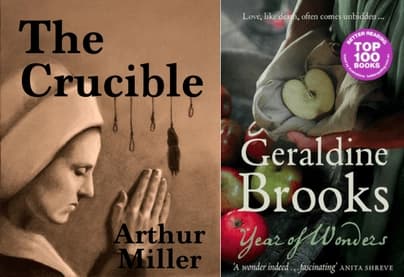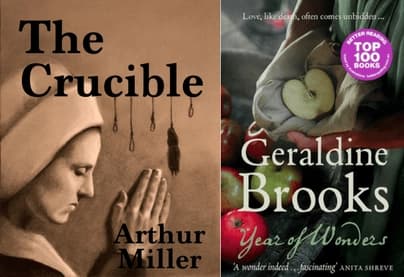

The Crucible and Year of Wonders are studied as part of VCE English's Comparative. For one of most popular posts on Comparative (also known as Reading and Comparing), check out our Ultimate Guide to VCE Comparative.
1. Introductions
The events of The Crucible begin with a group of young girls from Salem being discovered dancing and playing at witchcraft with Tituba, the slave of the town’s religious leader Reverend Parris. When his daughter Betty falls ill as a result, they and others seek to deflect blame away from themselves and simultaneously exact revenge against those they feel have wronged them. To do this, they are led by Parris’ niece Abigail Williams to begin a spree of accusations of witchcraft which result in the hangings of many of the other townspeople, including John Proctor, with whom Abigail once had an affair. For a full detailed guide on The Crucible as a solo text, head over to our The Crucible Study Guide.
Plague strikes a small, isolated Derbyshire village called Eyam in 1666 when it is brought there by a tailor carrying a bolt of infected cloth from London. The village’s population is decimated as a result, and in the resulting Year of Wonders shows her burgeoning strength as a healer and ultimately her escape at the conclusion of the novel to a new life.
2. Themes
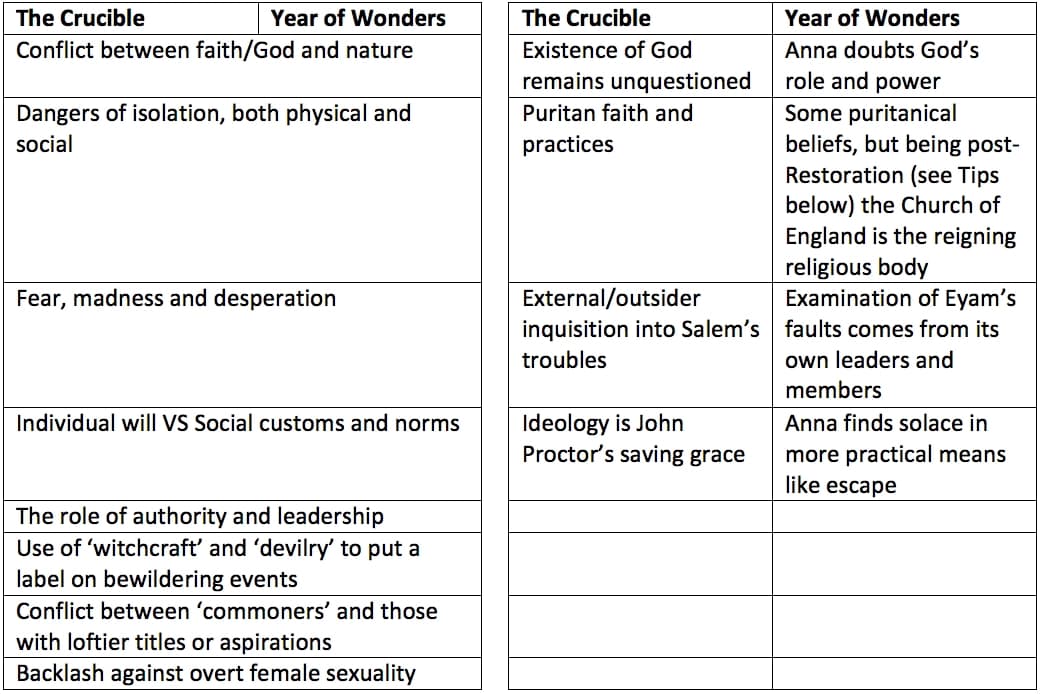
3. Character analysis
The Crucible
 Download this study guide here.

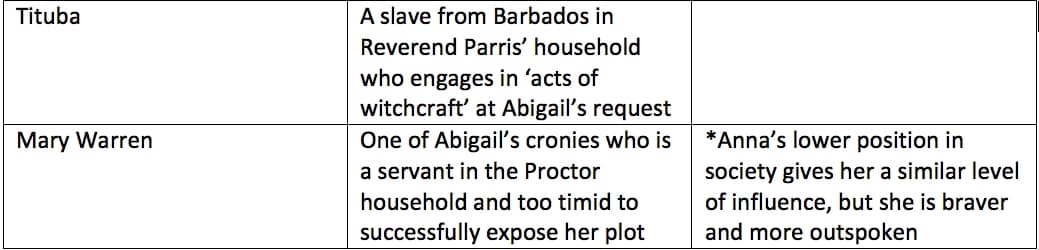
Year of Wonders


 Download this study guide here.
4. Sample paragraphs
Prompt: How do The Crucible and Year of Wonders explore the role of Christianity in their respective communities?
If you are looking for sample essay topics to use for your study, check out our The Crucible and Year of Wonders Prompts.
Introduction
In both The Crucible and Year of Wonders, the Christian faith is a central tenet of the lives of all characters, as both texts tell the story of strongly religious communities. It also acts as a strong driver of the conflict which occurs in both cases, but in quite distinct ways, and propels the action and development of many characters.
Body paragraph
While it is not the root of the troubles that develop throughout the courses of the texts, religion and the need to adhere to a belief system are central to their propagation and ultimate resolution. In Year of Wonders, the cause of the plague is as simple as the arrival of a disease carrier in Eyam, but is framed as a ‘trial’ sent by God for the villagers to face. Likewise the scourge of accusations of witchcraft that befalls Salem is simply a result of people straying outside the bounds of good behaviour dictated by their community, but is instead seen as an outbreak of witchcraft and consorting with Satan. As such religion becomes the lens through which both crises are viewed, and is used to try to explain and resolve them. Before the advent of more modern scientific practices, one of the only ways that inexplicable events such as outbreaks of infectious disease or mass hysteria could be understood and tamed was to paint them as either benign or malignant spiritual acts. This allowed people to lay the blame not at their own doors, but at that of something beyond them; for the people of Eyam, something which in truth was a chance epidemiologic event could be seen as ‘an opportunity that He offers to very few upon this Earth’. Because in both Eyam and Salem faith was already a familiar, stalwart part of everyday life, framing their respective disasters as acts of God or the Devil took away some of their fear, as they chose to see a terrible thing as part of something they had known since infancy.
Conclusion
Religion is far more than part of the everyday life and prayer of the common people of Year of Wonders and The Crucible; it is the foundation of their moral code and their way of explaining events which are frightening and make no sense. It also acts as a driving force within individuals as well as communities, deciding one way or another their actions and ultimately their characters.
5. Tips
Both texts are rich narratives on their own, but they are also strongly grounded in historical events that you may not have studied in great depth and which significantly influence the plot and characters’ actions – this is especially relevant when discussing the religion portrayed in the texts. You may miss many of the authors’ intended messages if you’re not aware of the full context of the books. Here are some ideas in this area that you might want to research:
 The Crucible also has a very interesting place in modern history as Arthur Miller’s comment on the rampant McCarthyism of 1950s America. Do some research on Miller’s life and views (the introduction or foreword of your novel might have some useful hints).
Also note that The Crucible is a play whereas Year of Wonders is a novel; how does each format uphold or reveal the author’s thoughts and ideas? How does the format of the text affect its other features (narrative, characters, voice etc.)?